
Can Solar Power Your Whole House?
Home - Blog - Can Solar Power Your Whole House?
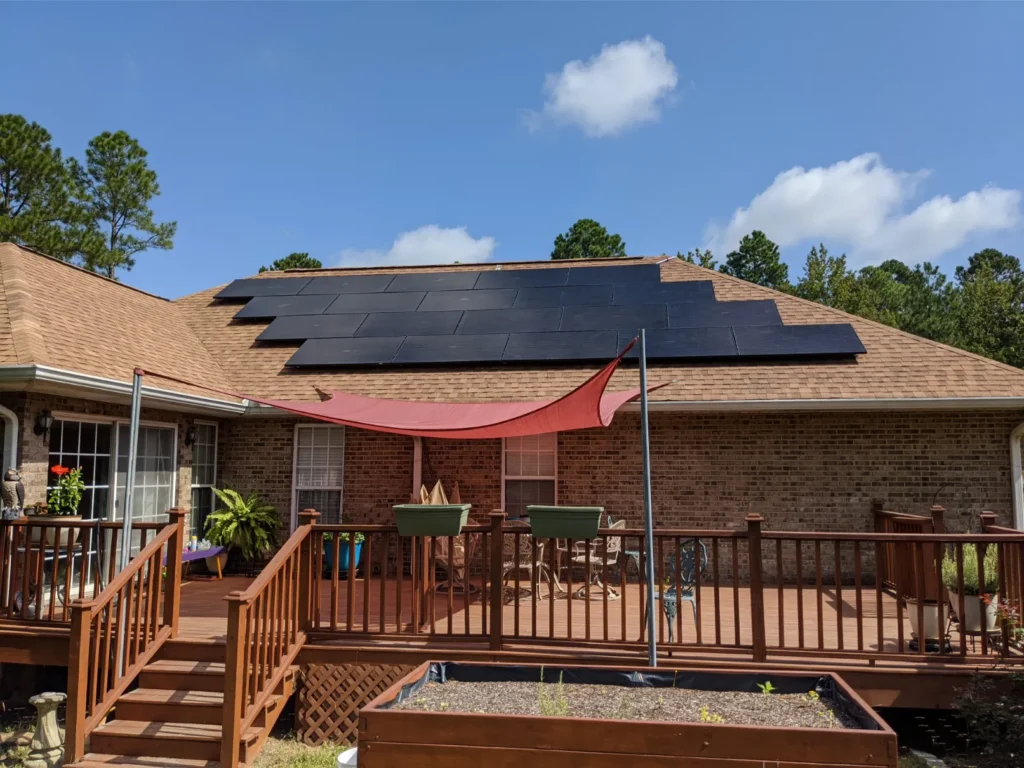
Yes — But “Power the Whole House” Can Mean Different Things
Yes, solar can power your whole house. As homeowners explore the best solar companies in Georgia, it’s important to understand what powering your whole house actually means. There is a difference between producing enough solar energy over a year to offset 100% of your electric use, powering the home directly from solar and batteries during an outage, and operating completely off-grid without relying on a utility at all.
All three are possible, but they are different design problems. A good solar design starts with your specific goals rather than simply covering every available square foot with panels.
100% Annual Energy Offset
For many homeowners, whole-house solar really means producing as much electricity over the course of a year as the home consumes. If a home uses 15,000 kWh in a year, a properly designed array may be sized to produce roughly that amount annually, subject to the site, utility rules, shading, orientation, and local weather.
That does not mean the house is physically running on solar every minute. During a sunny afternoon, the system may export excess energy to the grid. At night, the home may import energy back from the grid. Whether those exported and imported kilowatt-hours have equal financial value depends on the utility’s rate structure and net-metering or buyback rules.
Solar During a Power Outage
As a locally owned solar company in Georgia, we help homeowners understand that a standard grid-tied solar system usually shuts down when the utility fails. That shutdown is a safety requirement and prevents the solar system from energizing utility lines while crews may be working on them.
To keep the house powered during an outage, the system needs equipment designed to isolate the home from the grid and create a stable local power source. In practice, that usually means a hybrid inverter and batteries or another approved backup architecture. Solar panels can then recharge the batteries while the backup system powers the home.
Whole-Home Backup Is About Power and Energy
Battery size is measured primarily in kilowatt-hours, which tells you how much stored energy is available. The inverter’s output is measured in kilowatts, which tells you how much power the system can supply at one time. A home can have plenty of stored energy and still be unable to start several large loads simultaneously if the inverter is undersized.
Air conditioners, electric water heaters, ranges, dryers, well pumps, pool equipment, and other large loads can drive system size quickly. A true whole-home backup design has to account for both daily energy use and peak demand.
Off-Grid Is a Different Standard
A grid-tied home can lean on the utility when solar production is low. An off-grid home cannot. That means the system has to be designed around poor solar conditions, seasonal changes, battery reserve, and a realistic plan for extended cloudy weather. A generator is often a useful part of a serious off-grid design, even when the goal is to minimize generator runtime.
Off-grid systems are normally larger and more conservative than grid-tied systems serving a similar home because reliability matters more than maximizing annual return on investment.
What Ultimately Limits System Size
Actual energy use is the starting point, but the final design may also be limited by roof or ground space, shading, inverter capability, utility interconnection rules, insurance requirements, service size, and the physical layout of the property.
Future loads should be considered too. Electric vehicles, a new pool, a shop, a larger HVAC system, additions to the home, or simply higher household usage can all make today’s perfectly sized system feel small later. When the site and utility allow it, building in a reasonable buffer can make sense.
The Georgia Solar Pros Approach
We design around how the homeowner actually wants the property to operate. As a trusted solar company in South Georgia, we understand that some customers want the lowest-cost grid-tied system, while others need enough battery backup for refrigeration, lights, Wi-Fi, and a well pump. Some homeowners prefer genuine whole-home backup or a fully off-grid property.
Those systems should not all be designed the same way. The right system is one that matches the homeowner’s actual goals, property site, utility requirements, and budget.